Announcing PropAMM Factory

PropAMMs are gaining traction across blockchains, including Ethereum. Instead of relying on a passive on-chain pricing curve, market makers stream signed price updates to block builders. Builders include the latest applicable update before the trades that use it, allowing makers to adjust their prices throughout the block.
We covered this model in PropAMMs: pushing Ethereum to the next level of finance, where we also introduced our PropAMM Router.
The Router gives users and aggregators a single point of access to PropAMM liquidity on Ethereum mainnet. It requotes those venues on-chain when the swap executes and selects the best available PropAMM quote. This also helps protect against quote spoofing: a venue that advertises an attractive price and worsens it before inclusion has to compete again against the other venues. If the selected venue cannot fill the trade, the Router falls back to Uniswap V3 while enforcing the user's minimum output.
In our September 22 Router audit update, it was handling around $13 million across 1,000 swaps per day.
To dogfood the Router, we started collaborating with our partners at Zonda Markets on their PropAMM, El Zorro. Along the way, we realized that running a PropAMM is a lot of plumbing: contracts, exchange feeds, pricing logic, signing keys, builder connections, and monitoring. So we brought those pieces together in PropAMM Factory, an open-source repo for deploying and operating your own PropAMM.
The Factory brings together the two core parts of a PropAMM: the on-chain contract that fills swaps and the off-chain quote updater that publishes its prices.
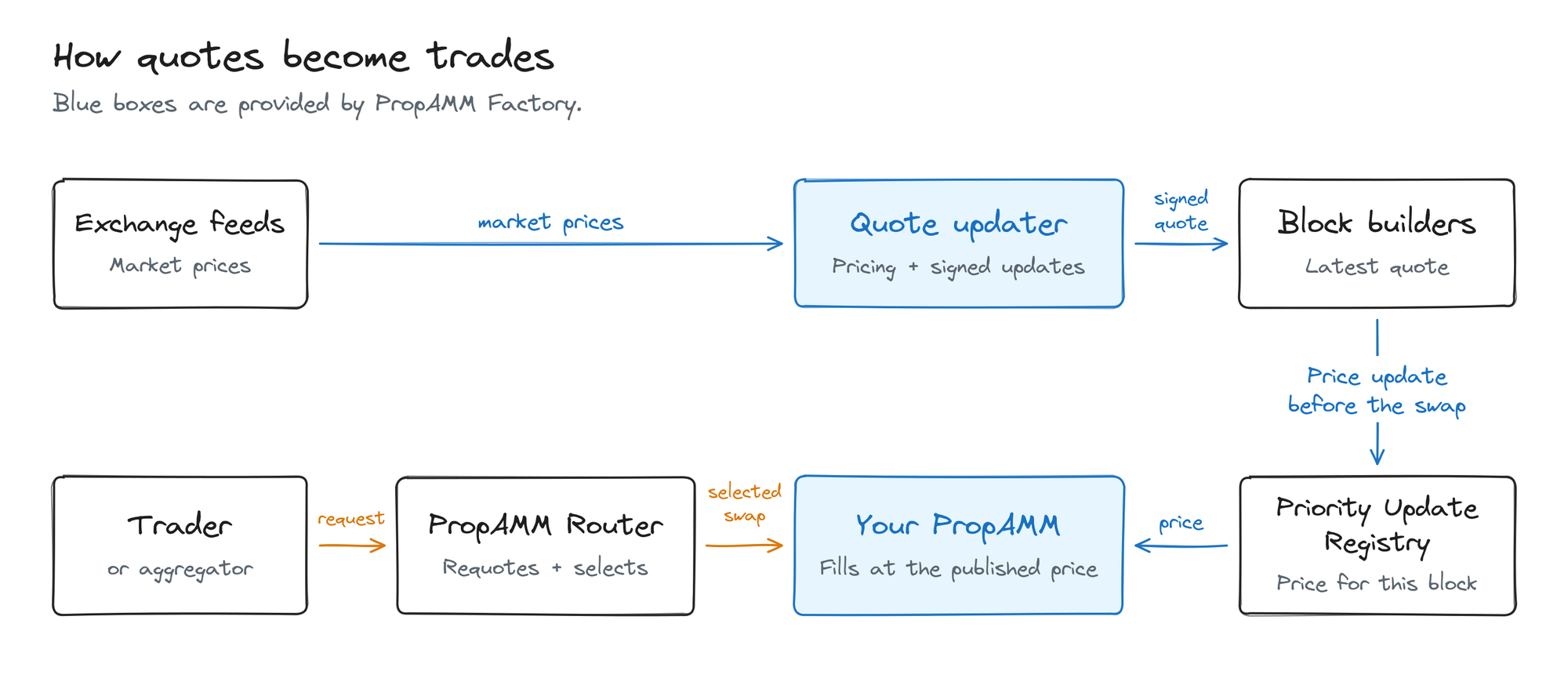
The quote updater connects to exchange feeds, runs a pricing model for each pair, signs the price updates, and streams them to your configured builders. A builder places the applicable price update before the swaps that use it, the PropAMM contract then reads that price from the Priority Update Registry and fills the trades.
You can choose the market feeds and pricing model for each pair. The included models support fixed prices, exchange prices, and spreads that respond to volatility and inventory. You can also implement your own pricing model, while keeping the same feeds, signing, builder connections, and operational tools.
Through a simple backoffice, you can change which pairs the updater quotes, choose their exchange feeds and pricing models, adjust parameters, and halt or resume quoting. The repo also includes landing checks, circuit breakers, Prometheus alerts, Grafana dashboards, and a Postgres recorder that keeps a history of published quotes.
You supply the capital, choose your pricing strategy, and arrange access to builders. The Factory provides the components that connect those decisions to live quotes and on-chain trades.
There are still things to polish and improve, but this is already what El Zorro uses on Ethereum mainnet.
Follow the production deployment guide, open an issue, and tell us what you think.
Contact us in our PropAMM telegram channel
Follow LambdaClass on X for updates.
